
Grinding
- Removal RateHigh (60-240 µm/h)
- SlurryNone
- Wastewater LoadLow
- Surface RoughnessSa: 0.5-20 nm
- Subsurface Damage LayerRemains (~several µm)
- Initial CostLow
- Running Cost Medium (abrasives/lapping plate maintenance)


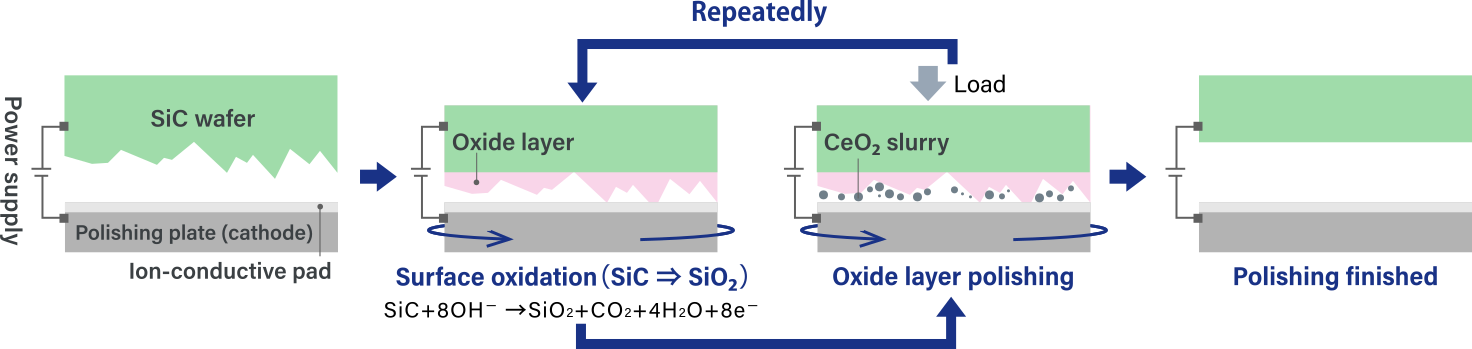
Achieves high material removal efficiency by softening the SiC wafer surface!
A chemical-free polishing process using an ion-conductive composite pad realizes low environmental impact and low cost!
SiC
SiC wafers, second only to diamond in hardness, are difficult-to-machine materials. JTEC’s ECMP uses electrochemical reactions to anodically oxidize the SiC surface and temporarily soften it, enabling efficient removal and achieving a high processing rate of 20 µm/h. In addition, by adopting an ion-conductive composite pad containing a solid electrolyte on the cathode side, the process eliminates chemical solutions and reduces environmental impact and cost.
POINT

Successfully improved SiC wafer processing efficiency by more than 10 times compared to conventional methods through an electrochemical reaction.
POINT

The ion-conductive composite pad enables a chemical-free process, significantly reducing environmental impact and wastewater treatment costs.
POINT

Mechanical polishing with CeO2 slurry enables surface finishing of Sa 0.2 nm or less.
POINT

Higher processing efficiency shortens lead time, and the chemical-free process lowers running costs.
“High Processing Efficiency”
“Low Environmental Impact”
“High Precision”
at Lower Cost!!

4H-N SiC Size: 4 inch, Processed Surface: Si-face

Before ECMP Sa: 26.4 nm

After ECMP Sa: 0.38 nm

Polishing Rate: 20 μm/h
Applicable SiC Wafer
Process Stage
Rough Processing / Planarization
Applicable SiC Wafer
Process Stage
Semi-Finishing to Finishing
Applicable SiC Wafer
Process Stage
Final Finishing
STEP 1

Consult with us on technology and systems.
STEP 2

In-person or web meeting based on your needs.
STEP 3

Test processing is available at any time.
STEP 4

Proposal based on needs and test polishing results.
SiC (silicon carbide) is a material with high hardness and stability, second only to diamond. Its importance is increasing in power semiconductors for electric vehicles and industrial robots, as well as inverters for solar power generation, making it an essential material for achieving carbon neutrality.
SiC is extremely hard, so mechanical polishing and cutting cannot remove material efficiently, resulting in longer processing time and increased tool wear. Although SiC has high thermal diffusivity, localized heat concentration can still cause surface defects, making it a difficult-to-machine material that requires advanced control for high-quality processing.
JTEC’s ECMP (Electro-Chemical Mechanical Polishing) is highly effective for SiC’s difficult machinability. ECMP uses electrochemical reactions to anodically oxidize the SiC surface and temporarily soften the hard surface layer, enabling efficient material removal. This realizes both high processing efficiency and uniform finishing, which were difficult with conventional mechanical polishing.
SiC offers high heat resistance, high breakdown voltage, and high thermal conductivity, and its applications are expanding in advanced fields. A representative example is power semiconductors for electric vehicles and industrial robots, which greatly contribute to higher efficiency and energy savings. Its use is also expanding to solar inverter systems, high-frequency communication devices, and high-temperature aerospace components, increasing its importance as a core material supporting next-generation energy infrastructure.
As demand for SiC continues to grow, technologies that overcome its machining difficulty and deliver both high quality and high efficiency are becoming increasingly important. JTEC’s ECMP achieves high processing efficiency and a uniform finish while reducing environmental impact. As the SiC device market expands, ECMP adoption is expected to accelerate and spread across a wide range of manufacturing processes.
For inquiries or detailed
information,
please feel free to contact
JTEC
Corporation.

| Model | EP100 | |
|---|---|---|
| General Specifications | Wafer Size | 6-8 inch |
| Applicable Wafer Material | SiC | |
| Number of Platens | 1 | |
| Polishing Heads | 1 | |
| Machine Dimensions | W1200 mm × D1210 mm × H2400 mm | |
| Machine Weight | Approx. 1800 kg | |
| Polishing Unit Specifications | Applied Load Range | 10-150 kgf |
| Polishing Head Rotation Speed | 10-90 rpm | |
| Platen Rotation Speed | 10-150 rpm | |
| Oscillation Stroke | ±55 mm(6″)/ ±30 mm(8″) | |
| Utilities | Power Supply | 3-phase AC200 V・60 A |
| Instrumentation Air | 0.4-0.6 MPa(C.D.A) | |
| Waste Liquid | Naturally discharged to the outside through a drain hose from the rear of the systems. | |
*Please contact us regarding wafer size.
C. N. S. B. C. Zulkifle, K. Hayama, and J. Murata, “High-efficiency wafer-scale finishing of 4H-SiC (0001) surface using chemical-free electrochemical mechanical method with a solid polymer electrolyte,” Diamond Relat. Mater., vol. 120, p. 108700, Dec. 2021.
J. Murata, K. Hayama, and M. Takizawa, “Environment-friendly electrochemical mechanical polishing using solid polymer electrolyte/CeO2 composite pad for highly efficient finishing of 4H-SiC (0001) surface,” Appl. Surf. Sci., vol. 625, p. 157190, Jul. 2023.
N. Inada, M. Takizawa, M. Adachi, and J. Murata, “Sustainable Electrochemical Mechanical Polishing (ECMP) for 4H-SiC wafer using chemical-free polishing slurry with hydrocarbon-based solid polymer electrolyte,” Appl. Surf. Sci., vol. 664, p. 160241, Aug. 2024.